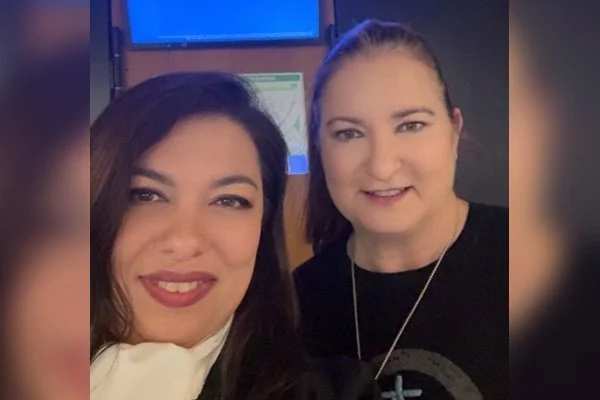
Dr. Ulpia-Elena Botezatu
00:35:11
Subscribe and listen on…
Apple Podcasts | Stitcher | Spotify | Google Podcasts | Amazon Music | PocketCasts | iHeartRadio | Player.FM Podcasts
Watch Full Interview
Show Notes
Continuing our space leader series, Dr. Ulpia-Elena Botezatu, Space Policy Officer at the Romanian Space Agency, joins us from the sidelines of the recent UNOOSA Commercial Lunar Activities and Space Law Conference at the United Nations in Vienna. Dr. Botezatu leads two major international bodies related to space activities: the Scientific and Technical Subcommittee of the United Nations Committee on the Peaceful Uses of Outer Space (UN COPUOS) and the Action Team on Lunar Activities Consultation (ATLAC). Dr. Botezatu shares her path to space and space governance at the UN, and the important work of these international bodies in paving the way for cooperation and peaceful activities in outer space.
Relevant episode links:
Ulpia-Elena Botezatu on LinkedIn, UNOOSA, The Portia Project
About Dr. Ulpia-Elena Botezatu:

Dr. Ulpia-Elena Botezatu is the Chair of the Scientific and Technical Subcommittee of the United Nations Committee on the Peaceful Uses of Outer Space (UN COPUOS) and Co-Chair of the Action Team on Lunar Activities Consultation (ATLAC). She is committed to advancing international cooperation in space law, security, and governance.
As a Space Policy Officer at the Romanian Space Agency, she represents Romania in major international forums, including the European Space Agency, the European Commission, the EU Space Surveillance and Tracking Partnership, and NATO's Science and Technology Organization, with a focus on space security and the peaceful uses of outer space.
Dr. Botezatu holds a PhD in Engineering Sciences and a Master's in Urban Management, bringing an interdisciplinary perspective to the resilience of critical infrastructure and space situational awareness. She has published extensively on the intersection of space and urban vulnerability, and is currently preparing a book exploring the role of space systems in shaping resilient urban futures.
In parallel, she is completing a degree in international law, with a specialization in space law, aiming to contribute to the development of practical, forward-looking legal frameworks that support sustainable, secure, and cooperative space activities.
Transcript
From Engineer To Space Policy: Dr. Botezatu's Path To The UN
Welcome to the show, where we chronicle women's journeys to the bench, the bar, and beyond. In this particular episode of the show, which we are broadcasting live from Vienna, Austria, at the UN, very pleased to have joined me on the show, Ulpia-Elena Botezatu. She has very important roles with the UN in terms of space law and policy. I am very excited to explore her career and some of the things that she is working on with the UN in the area of space. Welcome, Ulipa.
Thank you. I am very happy to be here.
Thank you so much for joining. Thank you for giving a few minutes on the sidelines of all of the space law meetings this week in Vienna. I wanted to ask first, generally, how did you get into space-based policy, just in general?
I am actually an engineer, not into space policy, but into space. I did not choose space. Space chose me, so to speak. I started in science. I somehow moved to diplomacy. I realised that the real frontier is not just technological, but it is governance. I always wanted to work for the UN. Unfortunately, I belong to a country which was and still is overrepresented within the UN system.
It was just in the back of my mind, always. The universe brought me here. I started doing representational work for the Romanian Space Agency about twelve years ago. I started with the European Committee's space situational awareness on space mission tracking. That would have been my field of expertise.
Slowly, I have moved into the European Commission, the ISO, International Standardisation Organisation. I also did some representation of the Nature Science, Science and Technology Organisation, the research branch of it. Eventually, a couple of years before the pandemic, I got into the UN. I was part of my delegation. Almost two years ago, I became the chair of the scientific and technical subcommittee of the UN Committee on Peaceful Outer Space.
One year ago, I became the co-chair of ATLAC, which is the Action Team on Lunar Activities Consultation. This is really a growing time for me. It has been a great growth. It was challenging, and it is also one of the greatest things I have ever done. Hopefully, we do not know what the future holds for us, but I hope I will continue doing that in future.
Those who may not know, those are some tremendous roles. Both of them play significant roles. The technical subcommittee itself is a full-time job. ATLAC, which is really an interesting new venture within the UN, to co-lead that is really amazing too. Both at the same time.
ATLAC is growing into more than one job. We have a lot of preparedness that we do before the meetings. We have meetings every month, more or less. That is really hard because we somehow need to guide everyone. We have to make sure that everyone gets to the same level of understanding. Otherwise, we cannot advance. Thinking about this beforehand and planning everything beforehand is actually quite a challenging task.
We have to make sure everyone is at the same level of understanding; otherwise, we cannot advance.
It is not just the meetings, it is the prep for the meetings.
The meetings are not very long in detail, 1 hour to 2 hours. That is fine, it is manageable. All the work that goes behind those two hours, let us say, meetings in the rooms of the Vienna International Centre.
Navigating UN Space Governance: The COPUOS Structure And Cycle
Some people might know, but others might not, who is listening in terms of the different UN bodies and how it all fits together. I know we had a little bit of a tutorial on that during our lunar commercial conference earlier this week. Maybe you can explain UN COPUOS and the Science and Technical Committee, and where that fits and what is in its library of work and then ATLAC. That might be helpful.
I will start with UN COPUOS as a general committee. It is the United Nations Committee on the Use of Outer Space that deals with outer space. It is formed by the member states of the committee, which are not the same as the member states of the UN. Currently, we have about 104 countries, members of the committee. More than 60, maybe even more than 70, nowadays, permanent observers of the committee.
The committee has two subcommittees. One is the scientific and technical one, where we meet every January and February every year. We are discussing technical and scientific aspects of the pieces we use in outer space. Whatever topics we identify as important for the scientific and technical subcommittee. Not necessarily the same topics, but legal aspects of those topics are then brought to the legal subcommittee, which usually meets in April and May every year.
After we discuss the scientific and technical aspects and the legal aspects, we go to the planary meeting, which happens every year in July. Every subcommittee, I should also say that every subcommittee ends with a report. That report is really a very substantive work because it reflects every single statement made in the room by everyone, member states and permitted observers over two weeks' time.
You can imagine it is very rich in information. That is the same for the legal subcommittee. The plenary endorses our works, the two works beforehand. With a report of the committee itself, we go to the fourth committee in the UN in New York. There are debates over there. The member states are all the UN member states. The ones who did not have the opportunity to be part of the committee can actually see what we have been doing.
There is another report there. It goes to the UN General Assembly, and then it gets voted on. This is how a whole cycle of UN COPUOS goes in one year, every year. It starts in January, late January, and then it ends somewhere in December. It also consolidates, year after year, the knowledge that we develop here because this is how we get the mandate. We have endorsed over the past year at the same time. I hope that clarifies.
It is really helpful because I understand it is almost like following legislation somewhere. You want to understand how it works and how it all fits together. It is important to know that in setting the areas that UN COPUOS is working on, there is a technical aspect and the legal aspect always together being considered.
One more thing that I have to mention. We also have UNOOSA, which is the United Nations Office for Outer Space Affairs. UNOOSA is not the UN COPUOS. It is actually providing secretariat work. We are a secretariat supporting the COPUOS. While the member states that are part of the COPUOS are leading this process, the UN itself is providing secretarial support with people with expertise, with rooms, with everything that comes with that.
ATLAC: Origin, Mandate, And Broader Stakeholder Participation
Which leads to our meetings this week. They are hosting us and having all of us learn new things and discuss things outside of the formal COPUOS process, too. ATLAC is interesting. It is helpful to understand the copious process. The action team on the lunar activities. Can you talk about that a little bit, because that is new? You are co-chairing it, but it is new.
Under the UN COPUOS, member states have established a couple of working groups. Probably you know about the working group on space resources. It is quite famous. A working group on the nuclear power source in outer space, a long-term sustainability working group. There are a couple more, the five UN treaties, and the delimitation of outer space. There are a couple of working groups. Some of them are under the scientific and technical subcommittee.
They report to the subcommittee. Some others are under the legal subcommittee. They report to the legal subcommittee. There is ATLAC, which is a different, easily said working group, but it is not a working group. Let us say that is foundational. It is an action team. ATLAC is an action team working to discuss. The aim of it was really to bring together expert-level professionals from everywhere, not only member states, but also from academia, from the industry, from NGOs, from really even individuals, to bring together these people all together to discuss whether we need an international mechanism for consultation on lunar activities.
That started in 2024, the COPUOS cycle in 2024. We agreed upon the mandate and the terms of reference, and methods of work that were in 2024. It was a proposal tabled by the delegation of Romania. Of course, that was just the manifestation of a wish that had already been discussed in numerous places in and around the UN. I would not say it was only Romania. Romania was the locomotive of this.
Many discussions eventually found a way of manifestation through that CRP conference paper. We made this proposal. In 2024, the committee endorsed the creation of ATLAC. In 2025, we decided on the leadership of it. This is where I, myself and my co-chair Hassan Abbas of Pakistan became the guardians of this initiative. Action Team, I was saying, it is like a working group, but it is not a working group because we have this mandate of being more than just member states.
Working groups at the UN COPUOS are formed by member states. The members are bringing forth their ideas and their mandate. In our case, we have the liberty, or we have this in our mandate. We have not figured out yet how to do it, but we have this in our mandate that we can incorporate perspectives from everywhere, from all over. This was one of the reasons why I said at the conference that we want to listen to what it says, because I believe that lunar activities are so important.
Space Governance: Listen to all voices because lunar activities are important and understanding them helps us grow together.
The way we are, it is so important for us to grow together and understand what those activities mean for everyone. In order to be able to grow together, we need to listen to everyone. Unfortunately, we have closed the group. That was also to protect the group because we had many, how can I say this, in a very elegant way. Every single meeting we had, we had to start from the very beginning.
It’s because new people were coming in many, “Here we are again.” You want to move forward. That is hard to do.
It was very difficult because we had a short mandate. It is a lot of work to do. Half of the meeting was just to explain why we are here. We state again, “What is our mandate? What are we aiming for?” Because of this, we decided to close the group. We have invited member states to nominate at least up to four experts. Of course, there were some delegations which only nominated people like diplomats from the permanent missions. I would like to offer if you give me this opportunity to offer the example of Romania.
We have been really thinking a lot, couple of months, about how to really nominate people in such a way that would be representative of the discussions within ATLAC. We have academia, we have industry, we have diplomacy, and we have a space agency. This is a good example. I am offering it because I hope that all the countries, all the members, will actually take this as a good example of good practice. Also, make nominations in that way.
It is a really good opportunity for that because, as opposed to COPUOS, where it really is member state-driven and that is who is involved in the discussions, in large part, the agencies and the governments. It is really nice to have a broader cross-section of people who are in each of those meetings to share their perspectives, which is really important in the lunar activities because we are talking about a range of actors being there. It is not just governments and the governments in partnership with private industry. Many different people need to have dialogue and to work together and to solve some thorny problems of being on the moon. It is nice to do that together.
This is what we were trying because, of course, from the very beginning, there were some websites which disagreed with the fact of including the industry, for instance. After all, it is still a UN-driven process. Websites are really on top of that. We really wanted to highlight the fact that it is not only the member states, where it is not only the industry, or it is not only the academia.
Solving Complex Systems: The Need For Preemptive And Sustainable Governance
It is all together. You need all those perspectives and voices in order to really see the whole picture. If you are creating or solving policy problems that folks who are used to policy see, but then you hear, here are some things we actually need answers to in industry in very practical ways. Like, “We should probably solve those problems too.” We should work together on those and understand what their concerns are.
The other thing I see in space, in general, the moon really exemplifies it, is that, really, we are not talking about just one group of actors added on top of another. We are talking about, at this point, like a whole complex system of actors. That complex system creates whole new emergent issues. You need to have those people percolating the issues together because that is how you will see what is going to emerge, and you will be able to be responsive, I guess, in a way that is more appropriate to what actually happens on the lunar surface.
Responsive is one word. To me is actually an after-action. What we are trying to do, or at least what I am thinking of doing currently, is really trying to be preemptive in the sense that we know this is going to happen. We know the risks. Some of them, maybe the major ones. We know what we did on Earth. Why don't we all sit together and talk about it?
What we learned from the past, from our lessons on Earth. What can we build together for the future in a way that we would not be reactive, but we would really be active and sustainable in our actions? This is what we are trying to do. Let us not break anything yet. Let us just set some rules of the road before we actually get to break anything in there. This is the noble part of our mission.
That is a role of the value of the UN in general as being a great container and convener. This is another avenue to do that to some degree, but very targeted to a particular set of missions.
The moon is only the first step. We have to have that in mind because, however we decide to design this route, so to speak, it is going to lead us further to other places in the universe.
You want it to be able to evolve. Whatever is concluded with regard to the Moon does not necessarily mean it is going to be the same thing somewhere else. You have to be open to that as well.
In terms of the international mechanism, international law, of course, it is every single example or every single planet that we are planning to go to is different, of course, but in terms of international law, how we build it or how we expand that, or how we understand international interpret.
That is true. That is right. You need to have a common sense of that.
We need to grow together because then it is going to be very difficult to justify actions or the work that delegations are doing under the UN. Why do we do the things that you did in that way? If we all have the same, not necessarily the same, but the same level of understanding, although it is not really the same, we could really sustainably advance things. Otherwise, some states are going to be much more advanced than others. Endorsing that divide is not a good thing. We have to go to the moon, and we have to do it together.
The Art Of Diplomacy: Leading With Consensus And Trust
I can think of two things that come to mind. One thing is that there is a lot of consensus building because that is how we move forward. Generally, in the UN, is through consensus. That is a different type of leadership. You are co-chairing this group, but you are really facilitating reaching consensus. How do you do that?
Perhaps I am one of those people who would prefer to do things like that. Consensual, that is. You are very right. There are ways of doing this top down, and there are ways of doing this bottom up. Bottom up is harder. I am trying to do bottom-up. Our role is really to facilitate these discussions because me and Hassan, cannot make decisions on behalf of member states.
We only take limited decisions with regard to how the process of member states finding their way. That is our basic, these are our limits. To do so, we are 3, 5, 100 steps before, so that we know where we need to go and then steer the discussions in such a way that it would be natural, organic to reach a particular goal. That is an art, but I think this is diplomacy.
It is 100%.
This is diplomacy in general. I got dragged into this, I said, and space diplomacy is particularly nice. I love doing this. I do not know. We will see in a couple of years whether we have been succeeding or not. Currently, we are in this process. It is very time-consuming, energy-consuming because I am also learning myself while I am doing it. I have not been to the moon. I have not been planning any mission. I have not been following any technical manner, any rover, or any lander, nor have I been doing that. I am also exposed to these discussions about missions or activities in and around the Moon. I have not been there. It is very hard to do something without actually doing it yourself.
On the other hand, it leaves an openness of curiosity that I think is actually good. It facilitates others' engagement and their being curious and trying to work out problems too.
I wanted to say that, in addition to this, it also means a lot of study. We are studying a lot, really. We are visiting space agencies, operational centres. We meet people and experts. I am studying international law now so that I can understand how this works.
I was going to ask about that. You have the technical side, but now you really need to understand the workings of that too.
I am finishing my bachelor's in international law at the university by the academic end of the year in 2026. Of course, I am focusing on space law, not necessarily space law, but on lunar law if I say so. My focus is really the moon. How can we think about the Earth and the moon together in a legal jurisdictional manner? I have not reached that point. I may be able to tell you more once I finish my graduate studies.
Congratulations. I am doing that as well as a few other things. You are working towards it. We will say congratulations because I know you will complete it. After all, you are just that kind of person.
Thank you so much.
ATLAC's Core Challenges: Interoperability, Lunar Dust, And The Road Ahead
Can you talk about some of the priorities or topics that ATLAC is considering for lunar governance?
What we have been doing in ATLAC is to invite member states to share whatever they want to share with us about their past, current, or future lunar activities or concerns, or whatever. Whatever they wanted to share with us was for two reasons. One reason is to help others who have not been there, or have not applied anything yet, to understand what kind of work or what kind of arguments lie in the back of such actions. That is one.
Capacity building exercise. Part of it, we are doing this together, we are growing together, so to speak. The other reason is to identify from the practitioners what are really the real challenges of going to the moon again are. We decided to cluster these challenges that delegations identified. We are in the middle of this process now. I can share with you some of the topics that popped out as challenges. One challenge was the selection of the landing sites.
We are doing this together, growing together.
Another challenge was the lunar dust. Of course, this is very general. What do we talk about when we talk about lunar dust? We really need to get into more depth with that. We also have some very generic challenges. Scientific missions, of course, this is again, not a challenge phrased as a challenge, but this is where we are right now. Mission planning. Mission planning is so vast. We do a lot of planning. Perhaps most of these ideas overlap.
We will probably, after discussions in intersessional meetings, get to some things of things. I am thinking that maybe interoperability would be one of the things. We will see. I do not know right now. This is where we stopped. Every month, we have an intersessional meeting. At every intersessional meeting, we have a couple of delegations that would like to present their activities. We have debates. We invite members to think about this debate and the presentation.
For the next intersessionals, we wrap up the past discussion. We decide together, those topics that we really need to address in case we decide to have international mechanisms for consultation. Our aim is really to decide whether or not we need such a mechanism. Of course, not to prejudge, but of course, we need to discuss. What we are trying to do from now on is at the scientific and technical subcommittee in 2026 to come up with a a proton draft of a line or 2 or 3 of recommendations that would reflect our debate.
That is to be embedded somehow in the report. That would be fantastic. The same for the legal and the same for the plenary. We would start 2027 with at least some words that we can build on. We could consolidate our perspective. Hopefully, we will be finishing it by the end of 2027. We have a mandate until 2028. Given the fact that life is at a different speed than the UN, we are really doing our best to speed up as much as we this process.
There are a lot of lunar mission plans relatively soon.
This is one of the things that we have heard very often. Whether the UN is obsolete or the UN is slow.
Actually, it is not.
Neither of that. That is because it is very hard to form a consensus. Just imagine having a big family and having to decide with twenty people around the table. That is already complicated.
We are talking about a hundred or more countries. Within that, you have your own inter-family debates.
Another 60, 70 family observers, who contribute to the debate. We would also like can share that with you, as we took this decision in our inter-sessional meeting. We have not done it yet, but we will do it in a short time. We will invite permanent observers to share with us written input on how they see these lunar activities. What exactly is of interest to them?
We will have every one of these permanent observers writing, I do not know, four pages. Imagine we have to read all that material. It is a lot of work. It is very difficult to attain consensus at the global level, taking into account various languages, cultures, understandings, experiences, and so on and so forth. I would not say we are slow. I would not say we are obsolete.
Understanding the full context, can say, “We are moving forward.” That is good. That is why I had asked about the leadership context, because I think leadership itself is challenging. In this context, you are really trying to facilitate people coming to their various conclusions. That is a different kind of art of leadership than in other scenarios.
Career Advice: Following Your Intuition To A Role In International Space Policy
It is challenging, but necessary within the UN process for sure. I had a question for you in terms of whether somebody is a younger person, maybe someone who is in science, in STEM, or somebody who is thinking about law school. What kind of advice would you give to them to become engaged in this international process with regard to space law and policy, and a career in doing that?
I can only think about myself.
Looking backwards, things that make sense, but along the way was meandering.
That is life. When I did my master's, I did it in Germany. It was a UN-led third degree, the Technical University of Berlin. Of course, I did not know much back then. I had this master's degree, which was UN-led together with the Technical University of Berlin. When I finished, before I finished, I had to do an internship. I said, “Where can I go and intern?”
“What do I like in life?”
What would I like to do or gain more experience in? I said, “Of course, if I am here, then it means I have to go to the UN so that I would feel complete in my understanding of the UN system.” I have applied from my group of colleagues. I was the only one applying to the UN. That actually shows the fact that if you want something, it is not that I was forced into that. I was literally the only one. The others went to aid agencies, international aid agencies.
I said, “I am really interested in this governance part.” I went into the UN. I was injured at the United Nations headquarters, the Secretary for the Convention on the Rights of Persons with Disabilities in New York. Which was absolutely stunning. It was an absolutely stunning experience for me. I had no clue about anything when I went there. It taught me what the UN means by human rights. I did not know much about that either. It was absolutely fantastic. Of course, I had to work from 10 to 6 every day because I was so into that.
I used to go like 7:30 or 8:00 in the morning and then leave really when my colleagues were leaving, which would mean sometimes even 11:00, 12:00 at night because it was the 50th, maybe 58th session of the General Assembly. There was so much work to do. They could not finish everything. We had informal consultations, of course. I was not allowed to go to the informed consultations because I was an intern. They took me there. Just sit in the corner there.
Just watch because that is how you look at things, right? By watching. People will ask somebody how they do something differently from watching them.
I was there. I took the opportunity. They offered me the opportunity. I took it. I was there. I listened. I also extended my internship there because I loved it so much. I really wanted to get in. Romania was overrepresented. That is why I said, “This is how we started our discussions.” At the end of the day, wrapping this up, I would say that I took the opportunities that were given to me. Also, the fact that I felt that I had to take them. It was an internal decision as well. I would recommend everyone who listens to us to really go with their gut and jump into things. That would be the advice.
At the end of the day, take the opportunities that are given to you.
Lightning Round: Heroes, Hidden Talents, And Dream Dinner Guests
Following where you feel you are called to be. Thank you so much. I really appreciate the interview. Usually, I end with a few short-answer questions. I am going to ask just a few of them. Let us see. Which talent would you most like to have, but do not?
I would like to have, but I do not.
Yes.
Public speaking. I would like to be more talented. It would be very helpful.
Remember what you are doing. Who is your hero in real life? Somebody you know.
I have two heroes. One is my husband because he has been, without asking anything, he has been there for me always. One cannot do this work unless one has support from home. He is my hero. I have another hero, my grandmother. She is 99. She is still alive. The way she has been offering us her values unconditionally is really wonderful. It is still guiding me in life. I always think about her. I am always hoping to see her very soon. It is complicated.
That is wonderful. I like both generations. Given the choice of anyone in the world, alive or no longer alive, who would you invite to a dinner party? It could be more than one person. It could be a group of people. Who would you like to have dinner with?
Eleanor Roosevelt. You know why? This is quite interesting, actually. Thank you for the question. It is reflective for me as well. When I was in the 5th or 6th grade, something like that. I had a poster in my room.
It was not the moon.
The real one probably was something that we would call today artificially made. It was something like the moon, the ocean, and there was a very nice light around the moon, which was bluish, something like that. Underneath the moon and the ocean, it was not dark, of course. It was written, “The future belongs to the ones that live in the beauty of their dreams.” This is a quote from Eleanor Roosevelt. I had that in my room for a couple of years until it got really broken and yellow. I really liked it. I was looking at it every day.
Feeling that calmness from the moon and from the sea. I always wondered, “What did that woman want to say through this sentence. What was her state of mind? What was she thinking of? What was she planning?” I would like to have dinner with her and ask her that. Ask her whether, back then, whatever she had in mind when she said this phrase happened. I would like to be asked when I will be out of it, maybe in 2029, one year after our mandate ends. What do I think about this?
That is amazing. That is beautiful and metaphorical and full circle. Thank you so much, Uplia, for discussing your work. Really inspirational of your approach to life. Taking opportunities, that is important for young people to think about and maximise them and to follow your gut and your intuition. Everybody could appreciate being reminded of that. Thank you so much.
I appreciate the opportunity. I hope you will ask them something.
We will have to do a follow-up interview. That is what we are going to do. That sounds good. Thank you so very much. I really appreciate this interview.