
Elizabeth Sanchez Chang
00:30:53
Subscribe and listen on…
Apple Podcasts | Stitcher | Spotify | Google Podcasts | Amazon Music | PocketCasts | iHeartRadio | Player.FM Podcasts
Watch Full Interview
Show Notes
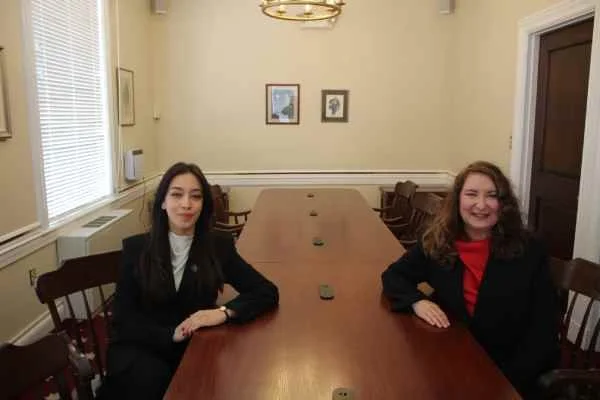
Law student and Founder of the American Space Law Foundation, Elizabeth Sanchez Chang, joins podcast host M.C. Sungaila from the sidelines of the Foundation's first national space law moot court competition in Washington, D.C., to talk about growing the next generation of space lawyers, the future of American space law, and being a social entrepreneur. The Portia Project was a proud sponsor of the competition.
About Elizabeth Sanchez Chang:

Elizabeth is a Matthew Isakowitz Scholar and JD candidate at American University Washington College of Law with a dual undergraduate degree in business administration and law from IE University. With space law & policy experience at Vast Space, Blue Origin and Schroeder Law PLLC, she is committed to building legal frameworks that enable the sustainable growth of the commercial space sector while realizing its boldest ambitions.
An award-winning advocate, she has earned honors at Harvard National Model United Nations, the Philip C. Jessup International Law Moot Court, and Geneva International Model United Nations. She co-founded and led IEUMUN, one of Europe's largest Charity MUNS, and now leads the American Space Law Foundation, a D.C. 501(c)(3) organization to train the next generation of space lawyers and translate legal ideas into actionable policy.
Transcript
Elizabeth Sanchez Chang
Welcome to the show, where we chronicle women's journeys to the bench, bar, and beyond and seek to inspire the next generation of women lawyers and women law students. On the show, we have a very dynamic guest, Elizabeth Sanchez Chang, the founder of the American Space Law Foundation. Welcome.
Thank you.
This is a big day for the foundation. Actually, a big week for the foundation. Yesterday was the inaugural National Moot Court Space Law Competition, the first domestic law, American law competition joining the Lachs competition for international space law, which will actually take place in DC next week as well. You have a great symposium and panel at the Cosmos Club, where we are recording this right now, which is a storied institution of thought leadership. It is a great place to have that discussion.
It feels unreal being here. It has had so much history and scientific discoveries behind it. I am really grateful to be here. I can think of the National Geographic Society was founded here, and also just the continuation of the salon environment of cross-disciplinary discussions, and just fostering that amongst the membership. The pictures of Pulitzer Prize winners that you can see in the entrance here is pretty impressive. You are adding to that disciplinary thinking.
I really do.
It is a good pedigree for the foundation to start with. I wanted to talk about your entrepreneurial journey with the Space Law Foundation and also your journey into space law. First, we will start with the law. How did you come to decide you wanted to focus on the law or go to law school?
Elizabeth’s Journey To Law And Space Law
Yes, going from the beginning. With law, I was always interested in law. That is what I wanted to do. Going to college, I did an undergrad degree in business and law in Madrid, Spain, at IE University. That was a big proponent on my law journey, just because in the United States, you have to do a pre-law and an undergrad degree before law school. Whereas, in my first week of classes, my undergrad year, I remember the first day my professor went, "Can anybody explain to me what the rule of law is?"
That is when I realized we were in the thick of it. I knew that that was going to be the start of a long but wonderful journey. In terms of space law, it was non-traditional. I would say it is not something that, as you know yourself, space is not really taught in many curricula in law schools around the world, including the United States. I used to do a lot of college debate, MUNs, that style. We had one at the UN headquarters in Geneva. I was so astounded. I felt so important. I thought, "Unreal to be there." I am really the delegate of Switzerland. It is my responsibility to represent them in this outer space legal committee, which is what it was.
The thing that really struck me the most was that it was called the futuristic legal subcommittee. It was on the peaceful uses of outer space and extraplanetary colonies. It does sound like science fiction. For me, it was fascinating. I thought it combined international law, administrative law, all these kinds of things that I was already interested in at the time.
In committee, I remember the first day, I got the sense of urgency by hearing other people talk. I thought, "We are discussing things that have already happened, right?" Debris fields that already exist, weapons that already exist or are being developed. I thought, "We need to start working on this as a whole, not just like the space law field, but from the beginning, with the students being aware," because nobody had told me about space.
Everybody thinks it is far off.
It is like not real or mysterious. After that, I caught the so-called space bug. It stuck with me since then. Everything I did kept going back to space. I remember my undergrad thesis, it was on the liability for damages of outer space objects, comparing governments and commercial actors. Believe me, it was on liability and insurance. I thought, "If I am not so bored or driven out of my mind by writing this by the end, space law is for me," because that means I am really locked in and interested in this. I am just a spoiler alert here.
That was like these really particular things that do not seem exciting, but they are to me.
That is how my journey into space law began.
That is so interesting. Sometimes different touchstones hit at the right time. There is that sense. I know at UN COPUOS, it is exciting on the one hand to have everybody convening in one place to discuss these very important issues. On the other hand, it is a very slow process by design. It seems like it does not quite match where things are going, especially in space now, which is much faster. All the technology, all the innovation, the companies, the government, so many more people out there. You have this process that is designed to be particularly deliberate and consensus-building. That is the process that is handling this behavior. It can be a little frustrating. I can understand.
The Slow Process And Hybrid Nature Of Space Law Policy And Customary Law
That is what I like about the law in particular, because it represents both the academic learning side, representing what humanity believes in, looking at a glimpse into our history, but also at the same time, the law is used not just to apply those rules, but to write them, especially from the tech law, or now here, but space law. That is one of the things that attracted me the most about using laws as a tool for the future.
What I love about the law is that it bridges ideas and action—it reflects humanity’s values and history, while also shaping the rules, especially in evolving fields like tech and space law.
In this setting, it really is a hybrid. The closest process-wise to what I do as an appellate lawyer, because it is a little bit of policy, it is a little bit of future thinking, not just a decision for these parties, but what are we doing to the law overall by ruling a certain way? All of those considerations come into the initial discussion in space law and policy, where we are trying to figure out what the implications of things are.
We are creating precedent as we speak, not just through litigation, which obviously there has not been that much litigation in the space field, but in the customs that we are creating, whether that be through governments or through commercial actors. It is a very unique intersection. We are seeing both creating the rules and the ground rules.
That is unique because there is a deep international law component to space law. Under international law, you can create law in writing, but you can also start creating essentially what I guess would be the equivalent of our common law in some way through this customary law. That is through the actions, the people who are acting and doing in that setting. That is unique. It does make it important for those actors to consider that. That makes it a little bit different. Tell me about the foundation, American Space Law Foundation, how you got the idea for it, and where you see its mission going.
The Vision And Mission Of Founding The American Space Law Foundation
It is definitely years in the making. I remember I first made the decision to create ASLF a year ago, literally on the day I decided that I would be a space lawyer. Because that day I realized, “It took me so much going out of my way and creating opportunities for myself and finding that usually, in law school, people have counselors and offices that help you with traditional fields of law, where more information is available. It was harder for me to really navigate and understand where my place in this field would be.
I thought, "I need to create something like a moot court, for example, or a space where students can get inspired to study and practice space law." I also thought of when I first discovered space law at the MUN and the urgency I felt that we really needed to act accordingly to how the field of law is changing by training future space lawyers as well to get the skills they need, because, as we have discussed, this is quite interdisciplinary. Space law is very interdisciplinary. ASLF, the vision for ASLF was not just students and practitioners, but bringing in the science, the engineering, the technology, and policies that we needed to inform space law and the frameworks being written.
Our mission is to pioneer American space law, not just through the moot court, but through post-moot research papers, collaborations with institutions like the Smithsonian Air and Space Museum with their digital learning challenge, and the AIAA. A lot of the supporters that we have right now, people that we are working with, are not even law institutions, because they all understand that space law requires collaboration with these other fields that usually run parallel to it. That is our mission.
I have a couple of questions about that. The first thing is I agree that it is very interdisciplinary, both within the law and outside the law space, where you are innovating the governance of the law, you need to draw by analogy and think outside the box in different ways. In many cases, I think the answer sometimes is not the law itself, but maybe it is an engineering way around something.
You need to consider all of those options. In that way, think like a general counsel when you are doing this because you are trying to find all the different tools that you can use to move forward in a way that makes sense. I had a question when you were speaking. I was thinking, when you say American Space Law, what is American about it?
For example, our case this year covers FCC agency action, which is uniquely American in how the United States regulates space activities. We have a commercial actor in the case of Terra LLC versus the FCC. This year has been extremely relevant with all the activities that FCC has been overseeing and all the things we see on the news regarding mega constellations and autonomous capabilities in space.
All these things that we want to do in the very near future. What makes it domestic is that essentially just the case pattern itself is American in the way it references the Telecommunications Act. We must acknowledge that space law is inherently also international. We have to consider the Outer Space Treaty, its principles, and how we are going to carry that forward into our domestic law and transform that into the future. At the end of the day, regardless of being in a domestic space, we all will inevitably affect each other, all space actors, because space is the promise of mankind.
That is right, in that it is a good description that there are layers to space law that, in this context, if you are a space lawyer, you need to understand the international layer, the Outer Space Treaty and its obligations that the United States has under it and then how that funnels down through domestic law and then part of that is our licensing system and our agencies. The other layer of that is administrative law and the agency decisions that are then made with regard to those licenses and applying that to novel technologies, as in the moot court problem with using AI for satellite navigation.
It is uniquely tailored to help students dip their feet into what space law looks like in practice.
I love that because I think that it also helps ground it, because I think the biggest question that I get most of the time is like "Space law, isn't that just academic and somewhere out there in twenty years, we might actually have a problem we need to address?" No, you do not want to wait twenty years.
It is happening right now.
It is helpful to show that "What does the space law program problem look like in US courts?" It is a federal appeal. It also helps students first recognize that it is happening now. If I want a career, there is something for me to do. There are problems to solve that are quite concrete in our courts. The second thing it shows is how well-rounded you need to be in order to solve those problems. You need the space law understanding so that when you argue things like the students did yesterday about the agency needs to consider the public interest, and the public interest also includes international law considerations, as well as national security and other issues.
It is not enough to just be a communications lawyer. You have to understand that. Where are you having these disputes? What kind of skills do you need for that? Are you litigating in the trial courts? Yes, but the agencies as well. The appeals from the agencies go to the federal appellate courts. You need appellate skills. To be a space lawyer requires specialized knowledge of space law, but it also requires a well-rounded understanding of what else is helpful for me to study so that I can apply this and have a particular role.
The Required Interdisciplinary Skills And Problem-Solving For Space Law
It is all about creating access to the field. One of the programs that we have is the ambassador program, where we have students who do not have law backgrounds essentially solve the same brief that the law students are solving. While it can be a little daunting at first, it is one of those things that we are trying to see where gaps exist in solving a problem that affects both communities, the law community, the science community, and seeing how each uniquely solves it with the training that they have.
You also need to understand it. If you are arguing one of these appeals or cases, you need to understand the technology. When somebody says, "How does this work?" or "How do we know the AI caused the satellite to steer wrong or to hit something?" It would be good to understand how the AI does that. That interdisciplinary problem solving is baked into the foundation from the beginning because of the Board of Advisors that you have, which includes me right now for law, and Dr. Lance Bush with a technology and science background.
I love that it is baked in originally, and it will continue on because Space Law requires creativity and looking outside a narrow frame for problem-solving. Which is also why I think a lot of this, like the skill building that you are doing through the foundation, yes, it will build future space lawyers, but also will build skills for if they want to do something else, or maybe something else before they go into a space subject matter. Well-trained for in-house lawyering to have this kind of thinking. Maybe at a Space company, but other companies do that, particularly any company that is doing cutting-edge work, drones, or other things like that.
We are helping give that skill set to become a translator between fields and this moot court especially, because beyond being a moot court for the law and developing writing, research skills, advocacy skills, we are making students get into perspective of the regulator, the person with the science background, the technologist and helping translate those ideas because at the end of the day, like a GC, for example, they will have to explain what the engineer has said to manage business development. Even if you do not want to be a space lawyer, participating in a move like this helps you create those new skills that we need, especially in emerging fields.
That really resonated too in terms of you have to understand who your audience is and what is important to them. What is important to a court of appeal in assessing a case, what is important to an agency, what is important to your various stakeholders in a company, and being able to adjust to that presentation and understanding what is important to each of them in their decision-making is something people would probably call a soft skill in law school, but it is actually an essential skill.
It is not something that you are really taught. You take your substantive classes, and you might have a moot court in something, but you do not have something that draws on all of these particular skills. It is really helpful for that. You are doing a great service to the future of our students and space lawyers. Also, their clients. Thank you for that.
Anything to help.
You are helping the whole ecosystem. I wanted to ask you, to some degree, the foundation and your work are serving in a mentorship role for the up-and-coming. I am sure that, usually, people who want to pay it forward have received some great mentorship too. I wanted to ask you about that in terms of mentors who have helped you.
If it is not as obvious already, I feel like I would not be here without the mentorship I have received, especially in a field where it feels like you are in the dark, taking steps in the dark, because, at least for me, I did not know what a traditional space lawyer path would look like. Some of my mentors I can think of just now are people who were not even space lawyers, and also space lawyers themselves.
Both fields, again, I have always been trying to integrate like an interdisciplinary approach to the way I want to see myself in my career and how I pay it forward as well. I remember one of my first mentors who was not a space lawyer, the biggest piece of advice I got from him was to be more bold and to be more confident in the decisions I take, even if there is not so much certainty, because he always said, "You have a mission, then you believe in it, it is bigger than yourself and other people believe in it too. Why not?"
That has pushed me forward so much. He also put me in touch with the space lawyers I was looking for. When I found my space lawyer community, I was like, "This is where I belong." I met amazing space lawyers, including yourself, who continue to inspire me every single day because there is so much I learn, not just on the technical side, but the soft skills you were mentioning and telling me, "This is what we need to prepare for the future." When I hear things like that, when I hear their experiences, it helps prepare me to help prepare the next project or the next thing that ASLF has in mind for other students who want to enter the space law field. It is a full circle moment. I would not be here without them.
Space Lawyer: When I found the space law community, I knew I belonged. The people I met continue to inspire me—teaching not just technical skills, but the soft skills we need to shape the future.
That is really the way you can repay your mentors, to pay forward in general. Sometimes you can help them, but it is really like paying forward what you have received to others. That is the way to go. Most people do not find entire nonprofits to pay back. I will say you are unique in that regard, Liz. I want to talk about that founder mentality, too. I see that in your business training and your law training together. You have the business skills and training, as well as the law training. What do you think it takes to be a founder?
The Founder Mentality: The Importance Of Having A Mission And Being Less Risk Averse
First of all, I think being a founder requires a mission overall. It requires something that drives you forward, so that even if you were not there, the mission can continue. Something bigger than yourself, larger than life. For me or for any person, and not to get too philosophical on this, we are held back by so many of our own personal obstacles. For example, it could be imposter syndrome or anything.
When you know that everything you are doing is going towards a certain goal, it makes things clear, sharper, and easier to do. Having a mission is the first thing. Second of all, and this goes back to the business background, being less risk-averse, taking big risks. I feel like lawyers, especially, or people with a law background, tend to be risk-averse. That is not a bad thing. That is what we are trying to do.
"What could happen? All these bad things that happen."
Despite that, I think being able to have a mentality to understand that there are unknown things, taking calculated risks, and being able to tolerate them. Personally, as a founder, it can be torture sometimes, or not knowing what is coming next, or if something is going to succeed. That combination is what I think sets a founder on the right path.
Your first answer was so interesting because I think when, especially now, there are myths around founders, and it is like, "It is all about that person." Actually, for that person to do what they are doing, they have found a greater meaning in it. To them, it is not about themselves. It is about some greater mission or greater purpose because why would you go through what you have to do to found something if there were not something on the other side that gives you hope and faith?
This is what I want to achieve. I am glad you said that because I think that it takes special people to take those kinds of risks, but the purpose of that is that the person can accomplish so much more. I have also seen that you have very good skills in team leadership. You lead your team quite well, and you have an excellent team.
You have chosen well as well. You are good at hiring collectively. By doing that, you have allowed the planting of the seeds for the possibility of it to continue with students continuing to be student-led after you are no longer a student, and you are practicing. That is very selfless of you to allow other people to have that opportunity to lead in the future.
I will say, sometimes when it comes to leadership or people coming into my team, some of the people on my team actually reached out to me. They found the mission and essentially asked me, "How can I join?"
You are filling a need. That is how you know you are on the right path. People are like, "I have that need too."
You found us so quickly. Day one, and I am just happy to have you on board, and it is exactly that energy that keeps us going. Most of our board is actually not law students. Only two of us are law students. Everybody else has a public policy or scientific background, traveling from places like Texas, so we have a good team.
The interdisciplinary part is also in the student realm. I had not really put that together, so that is pretty cool. What advice would you give to a law student who might be interested in becoming a space lawyer, besides becoming involved with a foundation?
Advice For Aspiring Space Lawyers: Embracing The Nonlinear Path
I would say do not be scared of a nonlinear path. Create opportunities for yourself. Do not be scared of doing that. Do not take no for an answer. If you know this is what you want to do, do not skirt around it. Do not say, "I will maybe approach it from this angle. That is a little less risky, like maybe do something that is related to it, but not exactly Space Law." If you feel in your heart that you truly want to do something and can contribute to it, why not do it as soon as possible? Why not wake up the next day and work hard towards your goal?
If you truly feel called to do something and know you can contribute, why wait? Start the next day and work toward your goal.
I would say that first. That is on the personal side. On the more professional side, know the industry. I would say, especially in law, that you are usually taught the skills you need as a lawyer. We are taught to have the advocacy, what rules apply to this law, etc. Especially in space, I think one of the things that helped me the most was staying informed. I am subscribed to every single newsletter. I have one email dedicated just to those newsletters. Payloads, Space News, T-minus. Staying informed on the industry so you are ready, and also brainstorm as things happen, “How to dispose of a law situation?” For example.
In fact, that is an exercise that my students do at the beginning of every class. It is Space in the News. They are required to present something new that has appeared in the news that week from their payload or space news. Once you start looking, you realize how much there is. Training them to start looking at, "There are real problems, how does this relate to the space law that we are studying?" The more you look for something, the more you see it. I have a green car, so I see more green cars. I see more space law problems. It is hard to keep up with all of it. That is when you realize, because if you look in mainstream legal news, you do not see that same coverage yet. You think, "There isn't anything happening."
That is not true.
I am just looking in the wrong place. Thank you so much, Liz, for talking about the foundation and your career, and advice, and I am going to end with the lightning round, the usual lightning round questions. Top tip for being an effective space lawyer.
Know your topic, know your audience.
You are so succinct. Good. Which talent would you most like to have, but do not?
Let us say a photographic memory. I think that is a good one. That is helpful.
I wish I had that too. I have half photographic memory, which is not helpful. You need the full. I could not remember which page, it is on the bottom of the page, and it is in this paragraph.
Do you know the page number?
No. You need the full thing. I would agree with that. What is the trait that you most deplore in yourself, and then that you deplore in others?
In myself, overthinking and others' arrogance.
You are very down to earth. Appreciate that. If you could wake up tomorrow having gained one quality or ability, what would it be?
The ability to speak any language I have learned. That would be it.
That is very helpful for the international part of space law. Also for travel. Those are all good. I like that. Here is a question you can choose. Who are your favorite writers? Or what is your favorite word?
My favorite writers, I guess, one is Ray Bradbury. I really like Ray Bradbury in science fiction. Remembering him makes me remember why I like space as well, and also the risk of space. He was clearly ahead of his time. I like Carl Jung, his psychology, and the concepts that he brings up as well in his writings.
The classics are really good. I brought an Arthur C. Clarke book with me to DC to read on the plane. It is amazing how much they really saw. “I want to see what happens next. Wait, he has already told us.” Who is your hero in real life?
My mom, definitely. She inspires me in everything I do. She pushes me when, sometimes, I do not know what is coming next or if I am having doubts, she is like, "Just go for it." She has always instilled that energy in me.
That is awesome. It is good to have that cheerleading support. Support, belief, all of that together. For what in life do you feel most grateful?
It is a similar one. I would say my family and my community. Everything I do, I think about my family, the way they have propelled me forward, and how much it means. I did not do everything alone. Everything I have done, there was somebody on the way who created this moment right now.
Sometimes, people, you will never know who they were because they were in a room saying something in your favor. You will never know that they did that. As you go on in life, you realize that it would not have just happened. Somebody had to have stood up, recommended me, or done something to move it forward. Dinner party. You can choose anyone with us or no longer with us. A single person or a group, who would you invite to a dinner party?
That is a classic question. On the theme of space, I guess, I would choose Neil deGrasse Tyson. I really like the way that he is able to make science and technical questions, and even philosophy, accessible to the average person. The way he tells stories, the way he communicates, is something I hope to emulate one day, and also something I think the space field needs as well.
There needs to be that communication and education, the public education component, which you are starting out with at the Smithsonian. Just call it into being, then, Liz, that Neil deGrasse Tyson will be at the next American Space Law Foundation speaking at the Cosmos Club for the next panel. That is it. Last question. What is your motto, if you have one?
Elizabeth's Personal Motto And The Foundation's Guiding Principle
We were just talking about this yesterday. I would say start before you are ready. That is it. If I had started when I thought I was ready, it was never going to happen. I am guilty of being risk-averse myself.
You are still a lawyer.
I am still a lawyer. At the end of the day, I am still a law student. Starting because I knew what I had to do, because I had that mission, before I thought I had everything ready, is what helped me make this. I advise anybody tuning in to really think about that when it comes to their goals. Do not compromise on your goals. Do not wait until you are ready. Just start.
When it comes to your goals, don’t compromise, don’t wait until you feel ready—just start.
In the process of doing, is where you find out what else needs to be done.
You will be ready.
You will find out as you go along what else you need. This is a good opportunity to also talk about the American Space Law Foundation's motto.
Yes, we have a mission patch now. I do not know if that is the first space law moot court mission patch that there is or a space law mission patch.
There is certainly no need for moot courts. It is the very first one.
The motto is ad astra per lex, which means as humanity goes to the stars, so too must the law.
Beautiful motto. Do not forget about the law. Thank you so much, Liz, for joining us and talking about your endeavor and the future of space law, which definitely includes you. You are very special. I hope that this episode will help law students who are interested in space law find the foundation and apply for the moot court next year, and have faith and hope in pursuing their dreams as well. Thank you for joining us.
Thank you.